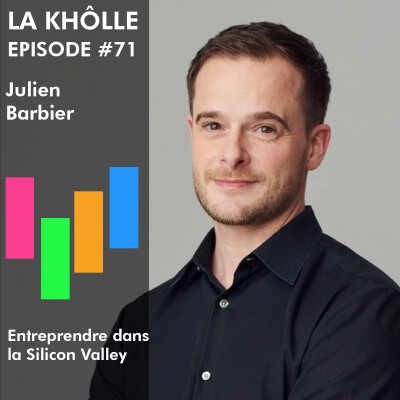
French Podcast: https://podcast.ausha.co/la-kholle/71-entreprendre-dans-la-vallee-julien-barbier
La Khôlle #71 Entreprendre dans la vallée – Julien Barbier 1h35 | 13/01/2023| 419
Description Un parcours juste incroyable à découvrir. Un enregistrement fait quelques semaines avant le rachat d’Holberton, l’école qu’il a fondé et porté sur ses fondations. Julien nous détaille toutes ses aventures et confirme par l’exemple qu’on peut rêver, oser et qu’avec du travail et de la persévérance, tout devient possible.
“Cogito, ergo sumo, Je pense, donc je suis, I think, therefore I am.”
René Descartes (1596-1650) French philosopher, mathematician and scientist.
Dear Members MDFDE and Friends Worldwide,
In the midst of Silicon Valley’s latest chaos in support of a global effort to slow automated AI developmenent, a most urgent controversy at the heart of diplomatic debates this week at the 81st session of the UN General Assembly in New York City…
When my friend Julien BARBIER, a French computer genius whose projects we have proudly supported since 2014 (see links below), contacted me a week ago — on September 14, 2026 — to let me know about the launching, that very morning, of CYBERIAD LABS, his latest venture with his Moroccan co-founder friend, Youssef Charif HAMIDI, a full-stack software engineer, inviting me to register for a free 4-week course, I really got excited.
Indeed, like many on our friends worldwide knowing so little about Artificial Intelligence, I worry about this “new world according to AI…” As always, education being the key for a better understanding of this highly critical situation we, humans, are currently facing, and eager to learn, I gratefully welcomed Julien’s learning proposition via CYBERIAD LABS and I hope you will too.
In solidarity with all humanists and citizens of the world,
Elisabeth Jenssen Founder & President
Le Mouvement des Français de l’Étranger (MDFDE) French and Francophones Abroad
– Friends of Laperouse USA – Friends of the Merci Train
Chair, #MDFDEFriendshipMerciTrain80
P.S. Here is more about what Julien BARBIER told me on September 14:
“If AI does the thinking, who are we?” Just last week, more than 25 education ministers said at UNESCO that learning isn’t served when AI substitutes for human judgement, a conclusion Julien totally agrees with, simply because, “The headlines worry about the day the AI and the robots wake up and kill us all. I worry about a future where one model, treated like the one true voice, decides what we think, how we think it and how we say it, because people have given up their critical thinking.”
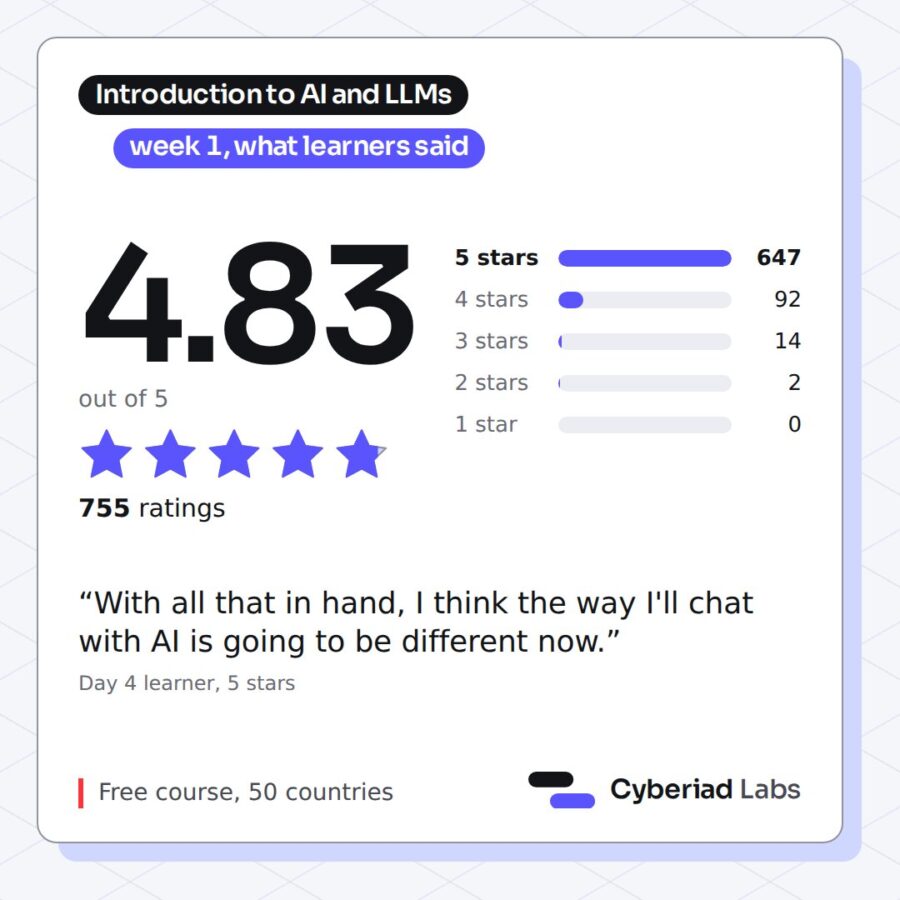
Our first course starts today. It’s free, online and four weeks long, and from the very beginning learners see that the thing that sounds so sure is a text predictor guessing one “word” at a time, with a product wrapped around it, and that it can and will be wrong. The 1,000 seats of this first class filled in less than 24 hours, with people from 50 different countries, and the November class is already full. It’s a first step toward our goal: 1,000,000 learners by 2030.
And here is what our former President Barack OBAMA said on September 15, 2026 via Twitter: Barack Obama @BarackObama ·
I was encouraged this week to see the leaders of the frontier labs agree on the need for them to slow down the pace of AI development. Given the stakes, it’s a good and necessary first step. But I’m even more encouraged by the growing recognition that how this powerful new technology develops should be at the center of our public debate. I’ve been watching the progress on AI for over a decade now, and one thing that’s clear to me is that the potential impact of this technology is not overhyped. It’s also moving at lightning speed – and even faster than those who are engineering it can keep up with. I’m not an AI accelerationist who believes it will lead to some techno-utopia, and I’m not a doomer who thinks it will inevitably lead to humanity’s destruction. But whether this technology results in amazing breakthroughs in medicine, energy and education or unleashes huge economic disruptions, greater inequality, and potential catastrophe will depend on the choices that we make right now – choices that should be made not just by the companies involved, but by all of us.
So, we need to use this time to structure a more open, public and democratic conversation about AI. Building on the statements that the frontier companies have already made, some leaders in the space announced they’re launching what they call Project Blueprint to help tech companies and policy makers work together on setting stronger standards and guidelines for AI development. Barack Obama (@BarackObama) / X
IMMEDIATE PRESS RELEASE:
Monday, September 21, 2026:
Why Cyberiad Labs exists
“I think, therefore I am.” If AI does the thinking, who are we?
TL; DR: AI is the most powerful and the most impactful technology ever created, and it is going to radically change every industry and almost every part of our lives. But too many people are using it in a way that makes them worse: they stop thinking, and they start sounding like their chatbot. Cyberiad Labs teaches how these machines work and how to work with them, so that you keep your own judgment and your own voice, and get faster and better at your work while you are at it. Our first milestone is 1,000,000 learners by 2030.
“Claude told me.”
We hear it every day now, and nobody adds “and I checked”. In fact, most people have stopped mentioning the chatbot at all: what it said is simply what is true, and there is only one truth. Ten years ago the phrase was “I saw it on TV”, and twenty years before that it was “it’s in the paper”. The chatbot is now the thing you don’t question, and unlike the paper it answers instantly and flatters your ego while it does. [1] It tells you what smart feedback you gave it, even when it was actually the dumbest thing you have ever typed. It will answer on any subject, including the ones it knows nothing about, and including the ones that are nobody’s business but yours. For some people today, ChatGPT, Claude, Gemini, and the others are deciding who divorces, what values children are taught, and how people vote. But their answers are not neutral and they will never be. David Rozado gave 11 political orientation tests to 24 of these systems, and almost all of them came out left of centre. [2] The same models in their raw state, before the companies “tune” them, do not lean that way. They do not flatter your ego. These things happen because these companies are deciding how the AI should sound and what it may or may not say. You didn’t make any of these choices. They were imposed on you by a small group of people who run the companies behind these AIs.
LinkedIn is one of the public places where you can watch people losing their personality, almost in real time. It has become a content farm where humans are the distribution layer for ChatGPT and Claude output. People add no work of their own on top, and I am not convinced they read what they post. Zero character, zero soul. It is almost as if these AIs were using people as empty vessels to spread their own vision of the world. And every braindead post is owned and represented by a real name and a real network. In July 2026, Originality.ai ran 5,000 public LinkedIn posts through its detector and 81.2% came out as likely AI, up from about half in late 2024. [3] There were nine different topics in that sample, and only one voice: the same opener, the same three bullets, the same closing question written with the exact same style and tone.
In 2025 an MIT Media Lab team put EEG caps on 54 people and had them write essays over four months, a third with ChatGPT, a third with a search engine, and a third without anything. The ChatGPT group showed the weakest brain activity of the three, and when asked to quote a sentence from the essay they had just written, most of them could not even do that. [4] Microsoft’s researchers surveyed 319 knowledge workers the same year and found that the more confidence a person had in the AI, the less critical thinking they did. [5]
The headlines worry about the day the AI and the robots wake up and kill us all. I worry about the day before, when we have lost ourselves, one prompt at a time. I worry about a future where one model, treated like the one true voice, decides what we think, how we think it, and how we say it. Nobody has to kill anyone in this scenario, because we do it to ourselves. I call it soul suicide.
I say this as someone who absolutely loves this technology. I use it every single day. My wife uses it every day as well, and my kids use it often. AI used the right way is simply incredible. I am still amazed every time I use it, and I think about how lucky we are to have it in our hands at all. I have spent my career teaching people to use technology, and until now, I have been focusing on building software. I started more than 10 years ago at Holberton, which I co-founded, then at ALX, where our technology and our programs reached 1.6 million people. Today, it is clear that the technology to focus on is AI. Because of all the reasons I talked about so far, and more practically also because my own learners are worried it will take their jobs. Maybe it will, in a few years, and nobody honestly knows. What is happening today is smaller and more certain. The person who will take their job will be someone who uses AI better than they do. It is no longer only what I believe, it is also what the data shows. 71% of business leaders now say they would rather hire someone with less experience and AI skills than someone with more experience and none, and 66% say they won’t hire without AI skills at all. [6] And the same jobs pay 56% more when they ask for those skills. [7] No job is staying what it was.
Of course we should use AI. The question is whether you still know what you think while you use it, whether you will still have a personality of your own ten years from now, and whether the decisions in your life are still being made by you.
Education is the answer to all the above, the way education has always been the answer. We have to explain to everyone how these machines work and how to work with them, so that you stay the person using the tool instead of becoming the tool these systems use. You get more of the work you actually want to do, and you do keep your voice while you do it.
With our courses, and from the very beginning, you see with your own eyes that the thing that sounds so sure, the thing people follow like a best friend or a god, is a text predictor, guessing its answer one “word” at a time, with a product wrapped around it. And that it can and will make mistakes. From there the courses go deeper with the same rule: you get more out of the AI, while staying yourself all along.
This work would be worth doing even if the technology stopped improving tomorrow. Staying who you are, with all your humanity, is not a bonus on top of a productivity gain. It is worth more than anything else. That is the whole point. It is also the only way the promise of AI makes sense. An AI has already predicted the structure of virtually all 200 million proteins that science has identified, work that won the 2024 Nobel Prize in Chemistry and is now in the hands of two million researchers in 190 countries. [8] Another one found an antibiotic that kills bacteria resistant to all known antibiotics. [9] I believe this technology will cure cancer, auto-immune diseases and every disease that we know of. It will give a kid in Kisumu the same tutor as a kid in Palo Alto. It will help us discover and explore new worlds. All of this is only worth it if we keep our minds and our characters intact. What is the point of building a better world if we don’t even know who we are anymore?
We cannot reach everybody alone, and we are not trying to. Schools, companies, non-profits and governments are watching the same thing happen to their own people, some of them worried about the thinking, some about the jobs. We want to be the platform that helps them. And with everyone’s help we want to enroll 1,000,000 learners by 2030.
We believe that this is the most important thing we will ever do. I built schools and programs for more than ten years and I was proud of them. But this matters way more. Not because of the jobs, although we will do the jobs part too. But because thinking is not something you should delegate to a machine. It is what and who you are.
Julien Barbier, co-founder, with Youssef Charif Hamidi, co-founder https://cyberiadlabs.com/mission.html
Julien Barbier
Co-founder of Cyberiad Labs • Former co-founder/CEO of Holberton School • Former head of Marketing, Growth & Community at Docker • USA Today & WSJ best-selling author
Infos
Julien co-founded Holberton, a software engineering school with no teachers, no lectures, and no upfront tuition. Backed by Jeff Weiner (Executive Chairman at LinkedIn), Jerry Yang (founder of Yahoo!), Solomon Hykes (founder of Docker), Ne-Yo, and Priyanka Chopra. He scaled Holberton from a single San Francisco campus to 32 campuses worldwide before the company was acquired by ALX, where he then led product and growth across Applied AI and Software Engineering programs scaling from a few thousand learners to serving 1.6M+ users.
Before Holberton, Julien was the first head of Marketing, Growth & Community at Docker, joining pre-pivot when the company was still dotCloud, recruited after selling his e-commerce business. His community-led approach and creative, out-of-the-box go-to-market thinking were instrumental in Docker’s explosive growth and developer adoption, helping take the company from $0 to a $1B+ valuation. Docker has since become near-universal and is used by the vast majority of professional developers and effectively the default for modern software infrastructure.
Julien is a Wall Street Journal and USA Today best-selling author, was named one of the top U.S. CEOs in the Education Space in 2022, listed on Vanity Fair’s Future Innovator Index in 2018, and won the EdTech Leadership Award for School Leader in 2017.
To connect with Julien:
– on Twitter: https://x.com/jbarbier
– on LinkedIn: https://www.linkedin.com/in/julienbarbier/
https://www.holbertonschool.fr/
To connect with Youssef:
https://youssefcharifhamidi.com/en#contact
https://youssefcharifhamidi.com/fr#contact
– on Twitter: https://x.com/YoussefCharifH2
– on LinkedIn: https://www.linkedin.com/in/youssef-charif-hamidi/
Related MDFDE/Friends of Laperouse USA/Friends of the Merci Train Posts:
MDFDE/USA: Grand Opening of the French-American HOLBERTON SCHOOL in San Francisco!
MDFDE/USA: Happy 2nd Anniversary Sylvain KALACHE & while42 SF Team!